
Behind the Numbers
Survivors of violent crime deserve policies that keep them safe and solutions that deliver true accountability. Arizona has invested in expensive ineffective policies that promise safety but fail to deliver.
Tough-on-crime politics has produced weak public safety infrastructure and Arizona needs to invest in funding justice that works for all victims.
Thousands of Arizona families are still waiting for answers. Tell legislators to invest public safety dollars in solving cases, finding missing people, identifying remains, and supporting survivors — not extreme punishments that do not deter crime.
Investing in Answers for Crime Victims
Unsolved Cases
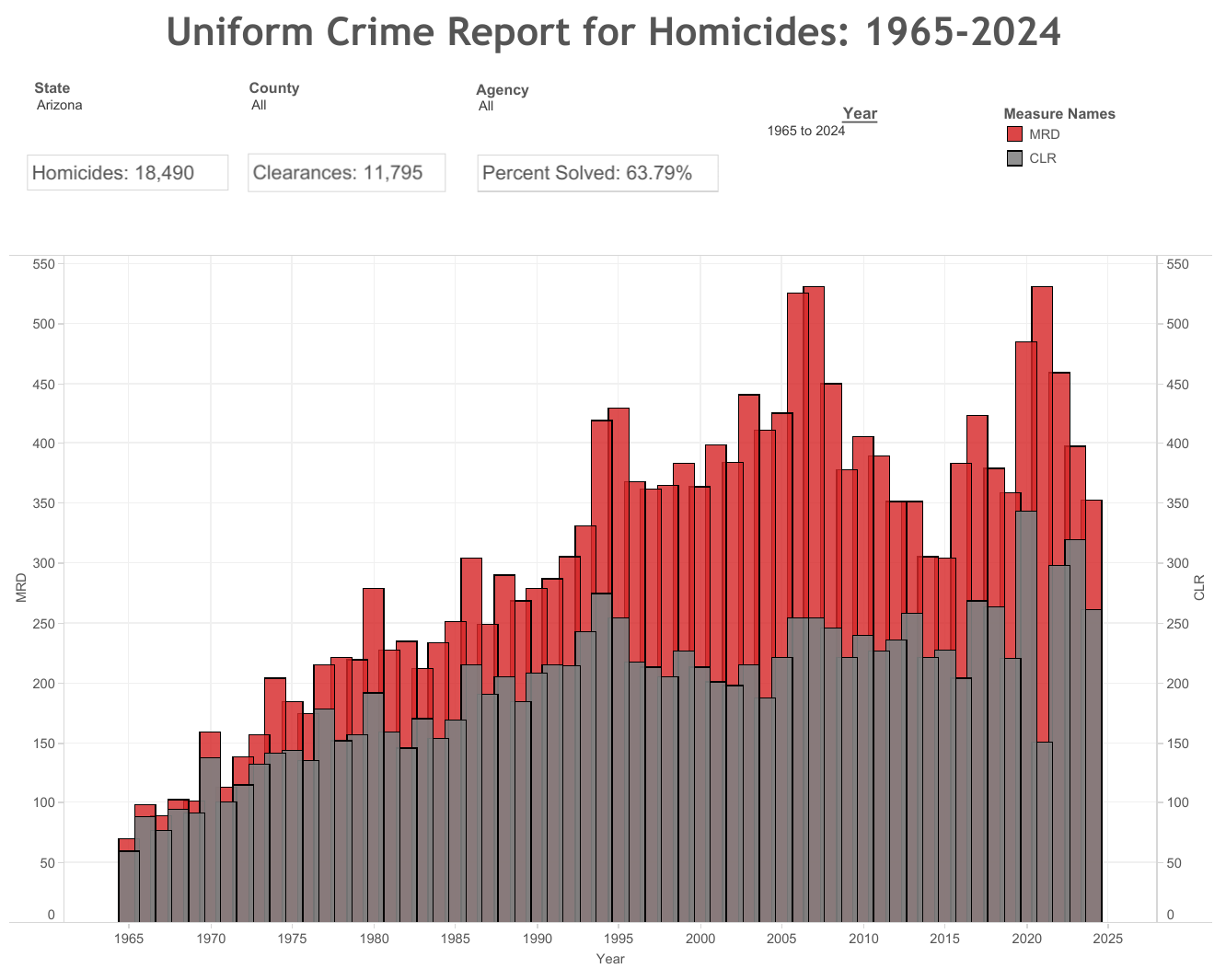
Source: Murder Accountability Project
From 1965 to 2024, Arizona recorded 18,490 homicides. Of those, 11,795 were cleared, leaving approximately 6,695 homicides unresolved.
That means roughly one in three homicides in Arizona did not result in a clearance.
For decades, Arizona has leaned heavily into punishment-first policy: mandatory minimums, long prison terms, and the death penalty.
The promise was public safety. But the data tells a different story. Homicides rose dramatically, especially after the 1990s, even as Arizona adopted some of the harshest sentencing policies in the country. The result was not a system that reliably solves violence. It was a system that became very good at punishment after the fact while leaving too many families without resolution.
Missing People
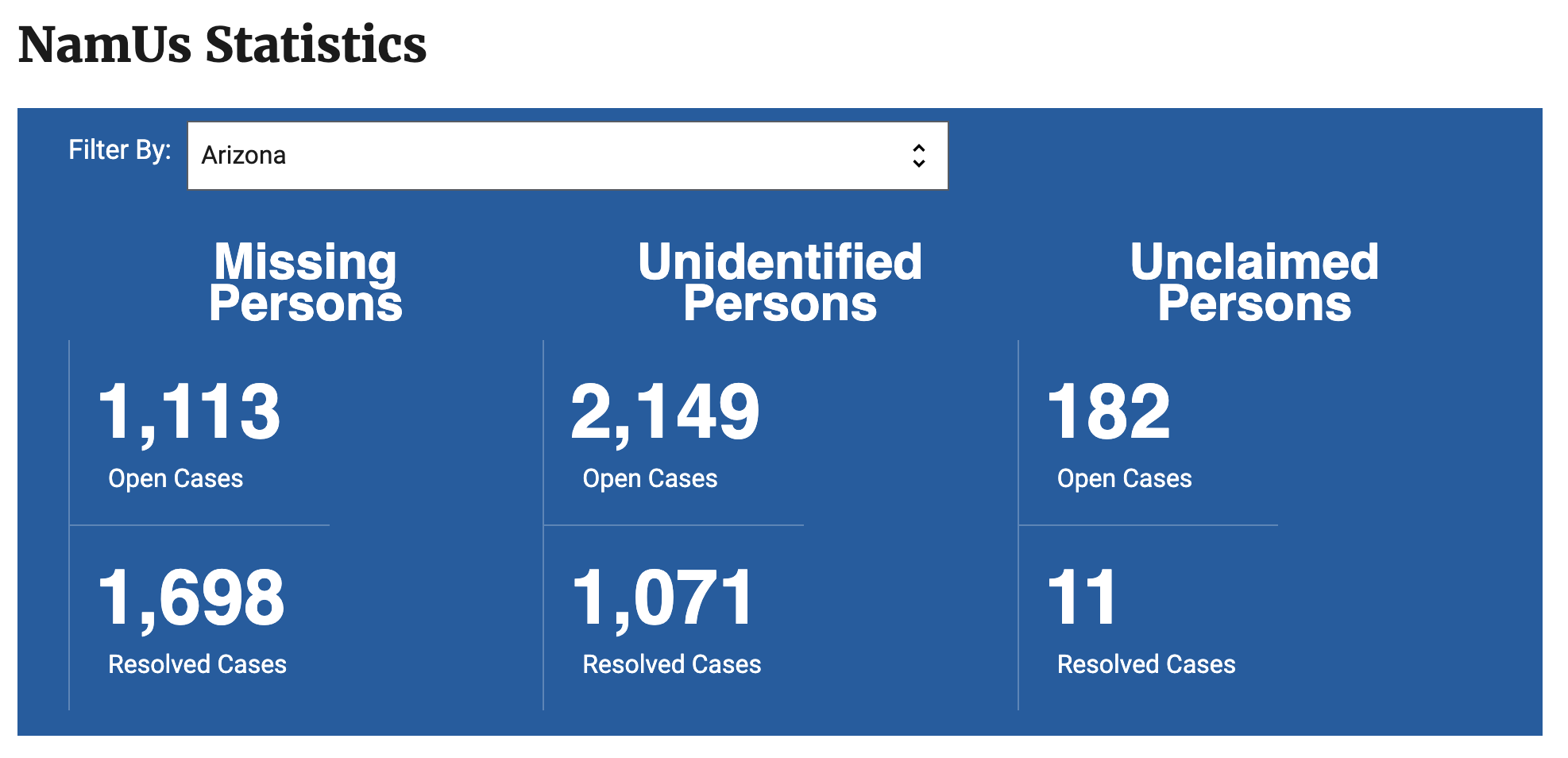
As of June 1, 2026 Arizona NamUs is reporting the following open cases:
Missing persons: 1,113 open cases
Unidentified persons: 2,149 open cases
Unclaimed persons: 182 open cases
That is 3,444 open NamUs cases in Arizona involving people who are missing, unidentified, or unclaimed.
This data matters because some unresolved homicides begin as missing persons cases. Some unidentified remains may be homicide victims. While all are not homicide cases, all are public safety and human dignity cases.
The Impact On
-
Delays in case resolutions leave families feeling isolated from the process and begin to question if progress is being made.
Failure to provide a timely response to victims' families creates significant stress and leads to them to scramble for support.
Families waiting decades for answers creates growing uncertainty. This ongoing doubt creates emotional damage and distrust in our safety and justice systems.
-
Unresolved cases in Arizona often remain under acknowledged and deprioritized by agency leadership.
Many agencies lack investigative units for unresolved cases. This impacts the time and attention for adequate response.
Limited and dated DNA testing can delay case resolution. Modernized forensic technology can improve and support case progress. Arizona has faced significant issues with backlog testing for years.
-
Arizona taxpayers have funded decades of punishment-first policy, but the return has not been a system that reliably solves violence.
We have paid for decaying prisons, death penalty litigation, and lengthy sentences for non violent offenses while thousands of homicides, missing persons cases, and unidentified remains remain unresolved.
Taxpayers are funding the most expensive response to the smallest slice of violence. Capital punishment focuses on a tiny number of cases while the broader universe of unresolved homicides, missing persons, unidentified remains, domestic violence, and community violence remains under-resourced.
Solutions
Cases should not depend solely on individual agencies' extra time or discretionary funding. Arizona needs clear policy priorities for unresolved cases.
Arizona needs dedicated funding solutions for regional task forces, family liaisons, and annual public reporting on unresolved cases.
Arizona needs to prioritize crime lab modernization as a core public safety investment. Forensic infrastructure is essential for solving crime, supporting families with answers, and confidence in the justice system.
Funding tied up in the most ineffective and expensive policy enforcements should be reallocated to implement solutions for families, violence prevention and interruption, and support for agencies solving crime.